Property of not the United States Government.
The FX-36 is planned to be powered by the General Electric XA100 adaptive-cycle engine, which was initially developed for the F-35 platform. The XA100 is an advanced, next-generation engine designed to provide a balance of high performance and efficiency across a range of flight regimes. Each engine is capable of producing a maximum thrust of 45,000 lbf (200 kN), and the FX-36 will be equipped with two of these engines, offering ample power to exceed the projected maximum takeoff weight. This power will support not only the aircraft’s high-speed performance but also its ability to carry and operate mission-critical systems, including the integrated GAU-22/A 25mm rotary cannon. The combination of thrust and advanced engine technology ensures that the FX-36 will have the necessary capabilities for both short-range and long-range operations, even in heavily loaded configurations.
The FX-36 is proposed to be equipped with the 25mm GAU-22/A rotary cannon, a lightweight, internally mounted weapon system weighing approximately 230 pounds. The GAU-22/A offers a firing rate of 3,300 rounds per minute, only slightly below the 3,900 rpm of the GAU-8/A used in the A-10 Thunderbolt II. Currently deployed on the F-35 Lightning II, the GAU-22/A has demonstrated reliability and effectiveness in multi-role combat aircraft. Based on preliminary evaluations—excluding full simulation and live testing—the system is considered a suitable and efficient armament for the FX-36 platform.
The FX-36 is designed as a next-generation multirole fighter, incorporating proven technologies from platforms such as the F-22 and F-35 to streamline development and reduce cost. Based on early projections, the estimated unit production cost is approximately $145.25 million, excluding fuel and long-term sustainment expenses. This estimate accounts for cost-saving measures such as modular systems, shared components, and advanced manufacturing techniques. Initial production would begin with a low-rate phase following successful testing and evaluation, with full-rate production anticipated thereafter. The FX-36 is expected to replace select F-35 units in frontline deployments, with roles focused on Close Air Support (CAS) and Joint Strike Operations (JSO), while enhancing interoperability with allied forces.
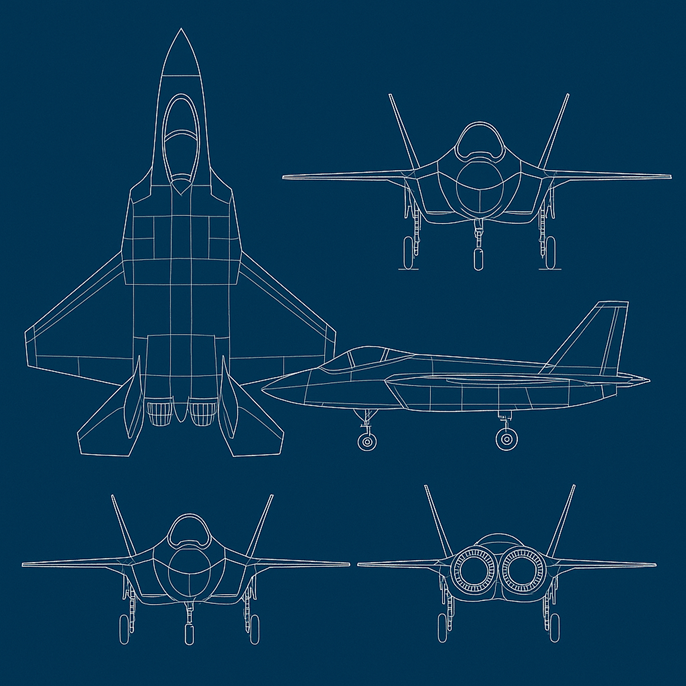
The FX-36 is projected to be a sixth-generation multirole stealth fighter, incorporating advanced design features intended to provide superior performance across a range of mission profiles. Preliminary estimates place the aircraft’s length between 55 and 58 feet, with a wingspan of approximately 40 to 43 feet and an overall height in the range of 14 to 16 feet. The maximum takeoff weight is expected to fall between 78,000 and 82,000 pounds, supported by two General Electric XA100 adaptive-cycle engines, each capable of producing approximately 45,000 pounds of thrust. These engines are anticipated to give the FX-36 a top speed exceeding Mach 1.8 and a combat radius of roughly 800 to 900 nautical miles, depending on loadout and mission parameters. To maintain low observability, the aircraft will feature a reduced radar cross-section through the use of radar-absorbent materials and an internal weapons bay. Its primary onboard weapon is expected to be a 25mm GAU-22/A rotary cannon, mounted internally, alongside a configurable payload of air-to-air and precision-guided air-to-ground munitions stored within enclosed bays. The avionics suite is projected to include sensor fusion for full 360-degree situational awareness, AI-assisted threat management and targeting systems, and secure multi-domain communications with electronic warfare capabilities integrated into the platform. The FX-36 will utilize a single-pilot configuration and is expected to enter service between 2037 and 2040, depending on development timelines and procurement priorities. With a projected unit cost of approximately $145.25 million—excluding fuel, munitions, and sustainment—the aircraft is designed for a service life of 70 to 90 years, with future upgrade paths anticipated as emerging technologies evolve.
The FX-36 is equipped with advanced utilities to enhance mission flexibility and survivability. Its integrated sensor fusion system combines radar, infrared, and electronic support measures to provide comprehensive situational awareness. The aircraft will feature next-generation electronic warfare (EW) capabilities, enabling effective countermeasures against radar and communications threats. In addition, secure multi-domain communication links will ensure interoperability with allied forces and unmanned systems. The FX-36 is expected to include satellite navigation redundancy, low-probability-of-intercept sensors, and fuel-efficient systems powered by the XA100 engine, enhancing its range and operational effectiveness in contested environments. These utilities enable the FX-36 to conduct a wide range of roles, including surveillance, target acquisition, and networked warfare.
The FX-36 is designed for a projected service life of 70 to 90 years, with operational service potentially extending into the latter part of the 22nd century, should it remain competitive against future generations of fighter aircraft. Its longevity will depend on continued technological relevance, periodic upgrades, and adaptation to evolving mission requirements. The aircraft’s lifecycle will be reassessed periodically to ensure its viability within the broader defense strategy.
The FX-36 will incorporate an advanced avionics suite designed to provide comprehensive situational awareness, precision targeting, and real-time decision support. Key systems include a multi-spectral sensor fusion engine that integrates data from radar, infrared search and track (IRST), electronic support measures (ESM), and satellite inputs to deliver a seamless 360-degree threat environment. The aircraft will feature a helmet-mounted display system (HMDS) providing augmented reality overlays, critical flight data, and targeting cues directly to the pilot’s line of sight. AI-assisted flight control systems will manage flight stability and mission execution, reducing pilot workload and enabling focus on complex tactical decisions. The flight control system will be fully fly-by-wire, with built-in redundancy and digital flight control laws to maintain aircraft responsiveness in all conditions.
The FX-36 is engineered with a comprehensive stealth profile, including shaping, materials, and emission control. Its fuselage design minimizes radar reflectivity through angular faceting and embedded control surfaces. The aircraft's surface will be coated with next-generation radar-absorbent materials (RAM) and infrared suppressive coatings to reduce both radar and thermal signatures. Engine inlets and exhausts will incorporate serrated edges and heat diffusion techniques to lower infrared emissions. Internal weapons bays and conformal fuel tanks maintain a clean external profile, reducing radar cross-section. Survivability is enhanced by advanced electronic warfare systems capable of detecting and jamming enemy radar and missile guidance signals, as well as a highly automated countermeasure deployment system for chaff, flares, and decoys.
The FX-36’s cockpit is designed around the pilot, with ergonomic layout and intuitive controls to optimize mission effectiveness. The single-seat cockpit features a panoramic, wide-angle touchscreen interface complemented by traditional tactile switches for critical functions. The pilot benefits from a voice-command system and AI co-pilot support to assist with navigation, systems management, and threat assessment. The helmet-mounted display integrates targeting, flight, and communication data, reducing the need for head-down instrumentation. Enhanced life-support systems include adaptive environmental controls and emergency ejection systems tailored for high-speed, high-altitude flight regimes.
Designed for operational efficiency, the FX-36 includes features that simplify maintenance and logistics. Modular avionics and engine components facilitate rapid replacement and upgrades. The aircraft incorporates built-in test equipment (BITE) and health monitoring systems that provide real-time diagnostics and predictive maintenance alerts. Logistics support is streamlined through standardization of parts across the FX series family, and the use of advanced manufacturing techniques reduces production lead times. Sustainment plans emphasize ease of repair, maintainability in austere environments, and integration with automated supply chain management systems.
Several variants of the FX-36 are planned to support diverse mission needs. These include specialized reconnaissance and electronic warfare models equipped with enhanced sensor suites and communication arrays. An unmanned variant is also under consideration, leveraging the FX-36’s airframe and systems architecture for autonomous or remotely piloted operations. Each variant maintains core stealth and performance characteristics while adapting payload and systems for specific operational roles.
While initially developed for U.S. military use, the FX-36 is projected to be offered to allied nations under controlled export agreements. Export variants may include modifications to meet partner requirements and compliance with international arms regulations. The platform’s adaptability and advanced features make it an attractive option for future allied air forces seeking next-generation multirole fighters.